Seven modern horror films you should watch

6 Aug

I talk about comedy a lot, and I write jokes on Twitter, so you might assume comedy is my favorite film genre. You’d be totally wrong. See what happens when you make assumptions? I’m actually a huge horror fan—not that horror and comedy are mutually exclusive. And since I’ve already made a post telling you what comedies you should watch, I figured I might as well do something similar for horror. While I have a great appreciation for the classics (favorites: A Nightmare on Elm Street, Halloween, Night of the Living Dead, Rosemary’s Baby), I wanted to focus on films made in the 21st Century. (Look, I had to narrow it down somehow.)

So here are seven modern horror films I think you should watch, in no particular order.

1. Jennifer’s Body (2009). Written by Diablo Cody, directed by Karyn Kusama. I lied. This one’s first because it is my favorite modern horror film. It’s also one of the most unfairly maligned movies in recent memory. This is a sharp, witty, and—best of all—female-centric horror movie. It’s certainly not the scariest on the list, but it appeals to my sensibilities perfectly. Horror can be funny without being silly; it can offer social commentary without hitting you over the head. And why all the Megan Fox hate? This role is perfect for her. Bonus points for the queer undertones, which are overt long before the girl-on-girl action.
You might also like: Ginger Snaps (2000). Another great blend of horror and comedy, with strong female characters and high school metaphors.

2. Hostel: Part II (2007). Written and directed by Eli Roth. I once got in an argument with a friend over this movie. She said she could never watch it as a feminist and a human rights activist—I guess the implication being that I hate women and love torture. Which, uh, no. In many ways, this film is a play on the rape-revenge genre (I Spit On Your Grave, The Last House on the Left), so, yes, you see women suffer. But the women are your point of identification, and there is great satisfaction in the revenge. If you’re being tortured in the first half of the film, you’re also—spoiler alert—castrating your captor in the second.
You might also like: The Devil’s Rejects (2005). Lots of torture, but Rob Zombie’s film is interesting for the way you’re forced to identify with the torturers.

3. À l’intérieur (Inside) (2007). Written by Alexandre Bustillo, directed by Alexandre Bustillo and Julien Maury. Of all the movies on the list, this one was the hardest for me to sit through. It is completely brutal, a product of a movement Artforum’s James Quandt dubbed “New French Extremism.” Thematically, the story of a pregnant woman terrorized by a woman trying to steal her unborn child is horrifying. That aside, the violence is shocking and relentless. It’s also completely necessary to the film. Even if you have to watch this movie through your fingers, you have to watch it.
You might also like: Trouble Every Day (2001). Another New French Extremism movie with Beatrice Dalle, who is honestly just really scary.

4. Frozen (2010). Written and directed by Adam Green. You know what’s scary? A seemingly invincible urban legend serial killer. (Green’s Hatchet and Hatchet II.) You know what’s scarier? Getting stuck on a fucking ski lift. Frozen tells a very simple story: three friends are left hanging on their way up a snowy mountain. They have to survive frostbite, hunger, and wolves—things most of us don’t have to contend with, but that are grounded in reality. Frozen does a great job making the open air feel like a confined space—these three are outdoors, but they have nowhere to go. That sense of claustrophobia is palpable throughout.
You might also like: Buried (2010). Perhaps more thriller than horror, Buried is one of the best claustrophobic film I have seen.

5. The House of the Devil (2009). Written and directed by Ti West. This is a bit of a strange pick—not because it isn’t great, but because the film takes place in the ’80s and is very much indebted to the decade. Nevertheless, it is a modern horror film that is remarkable for the way it avoids and subverts so many modern horror conventions. I’m also a big fan of movies that traffic in subtlety, only to arrive at an over-the-top conclusion. The huge reveals aren’t what makes it scary—that’s the suspense. But the switch from creeping dread to “holy shit” is a fantastic mindfuck. You thought you knew what was going on, but you had no idea.
You might also like: The Last Exorcism (2010). Without giving too much away, this movie’s structure shares a few notable features with The House of the Devil.

6. Splice (2009). Written and directed by Vincenzo Natali. Yes, really. Here’s yet another movie I think most critics just didn’t get. It does have its share of ridiculous moments, though I’d argue all are intentional. In some ways this sci-fi horror film could also be called a dark comedy, but that doesn’t make it any less disturbing. There are plenty of movies about science gone wrong—don’t mess with mother nature, and all that—but Splice also includes incest, rape, and pedophilia. These aren’t intended to shock, but rather to unnerve the audience, and it is indeed a movie to squirm through.
You might also like: The Fly (1986). OK, it’s not a post-2000 movie, but it’s a classic, and you should watch it immediately.

7. The Hills Have Eyes (2006). Written and directed by Alexandre Aja. Let’s get this out of the way first—I am a huge fan of Wes Craven’s 1977 original. But Aja’s remake of The Hills Have Eyes is one of the few recent horror reboots that gets it right. The film follows the original pretty closely, until a certain point at which it goes off-the-walls crazy. In my mind, a good remake should honor its source material, but also expand on it. Not to mention the fact that Aja, a New French Extremism director, has a fantastic style. I loved about half of Haute tension, but he lost me with the awkwardly homophobic twist.
You might also like: The Last House on the Left (2009). While it’s not perfect, it also does some interesting things with Wes Craven’s original. Plus, Aaron Paul!
A conversation with Michael Ian Black

4 Aug

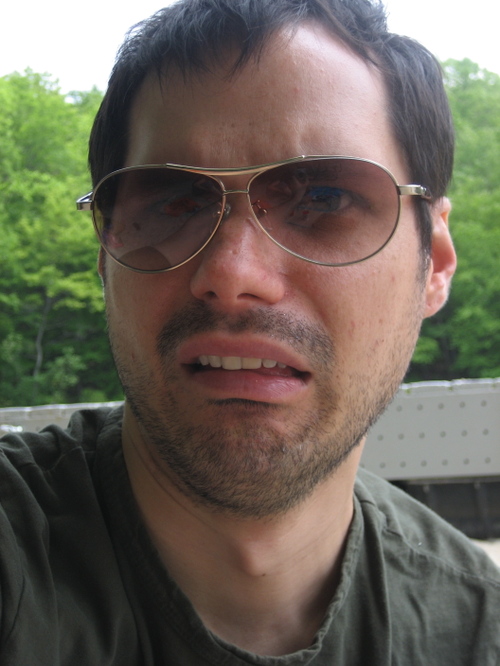
Photo courtesy Michael Ian Black.

Michael Ian Black needs no introduction.

Ugh, OK, fine. He’s a comedian and an actor and a tweeter. I asked him if I could do an interview to promote “Very Famous,” his upcoming Comedy Central stand-up special. Mostly I just wanted to grill him about his recent diagnosis of bursitis in his elbow. Does that count as gotcha journalism? Maybe. Here is a complete transcript of our conversation—you decide!

Louis Peitzman: Normally I prepare a bunch of questions in advance, but I just wrote these in the last five minutes. So they’re going to be really…
Michael Ian Black: This is going to be a freewheeling conversation.
LP: Yes. Basically. I wanted to start by asking the question on all of our minds, which is, how is your elbow feeling today?
MIB: Thank you for asking, and I know that everybody is concerned. I’ve been getting a lot of emails, a lot of texts, some telegrams from overseas. And the thing that everyone wants to know is, what’s going on with your elbow? Is your elbow OK? Are you gonna die? And after seeing the doctor, he prescribed some antibiotics for my bursitis, and he told me I should start feeling better within 48 hours. So, we’re gonna see. I think we’re all entering the wait-and-pray period right now.
LP: Are you disappointed that it’s not gout?
MIB: I am disappointed. Well, I’m disappointed because I really liked saying that I have gout, and I really liked saying that I have elbow gout, for all the obvious reasons. On the other hand, apparently once you get gout, you’re susceptible to getting it many times in the future. And having this experience, I don’t feel like I need to relive it. And the comedic effect will diminish over time if I keep saying I have gout. Like Chicken Little, eventually people will grow tired of that. They’re not gonna respond to it in any way, shape, or form.
LP: Well, I wanted to ask a little about your special.
MIB: You don’t want to talk more about my elbow?
LP: I mean, I do, but I feel like people might want to hear about what you’re doing on Comedy Central.
MIB: OK, but my health…
LP: Your health is kind of secondary to that.
MIB: [sigh] All right. Let’s talk about my special. I don’t care.
LP: Why did it take you so long to get a stand-up special on Comedy Central?
MIB: I never tried before. ‘Cause I didn’t really do stand-up before. I started doing stand-up a few years ago. And then I signed with this new agent, this new stand-up agent about a year ago, maybe a little bit more. And I said, “What do you wanna do?” And he said, “This is what we’ll do—you’ll go on the road and then in about a year, we’ll do a Comedy Central hour-long special.” And I said, “You can just do that? You can just say, ‘I want to do a special,’ and they’ll say, ‘OK’?” And he said, “Don’t worry about it.” And then that’s what happened. I don’t know if he had to pay somebody off. I don’t know how exactly it came to be. But he just said we’ll do that, and then we did it. Can’t argue with that, somebody in show business who keeps their word.
LP: Now, what’s the main difference between stand-up and being a talking head on VH1?
MIB: You see a lot more torso in the stand-up. And if you’ve got a torso like I do, that’s something you want seen. Do I have rock hard abs? No. But I have gently cascading abs. That’s the main difference—my abs.
LP: How do you stay in shape when you’re traveling?
MIB: I do what Wham! did when they were getting ready to go out on their “Make It Big” tour, which is, I played badminton for hours and hours and hours.
LP: Wow, that’s a lot of badminton.
MIB: It’s at least three hours. But that’s what they did, and it worked for them. I see no reason to change something that’s already working. And, what’s nice is, I got Andrew Ridgeley to play badminton with me. He wasn’t doing anything.
LP: The title of your special is “Very Famous.” Are there any other celebrities out there who understand where you are, fame-wise?
MIB: I think there’s probably a handful of celebrities who kind of understand the rigors and the trials that I go through on a daily basis being very famous. The Dalai Lama comes to mind. Vladimir Putin comes to mind. Silvio Berlusconi. Neil Armstrong. Bigfoot. I think that’s probably it.
LP: And some of those people aren’t even on Twitter, so they don’t really get the full effect.
MIB: Well, without giving away too much, they all are. But a lot of them don’t want to be found on Twitter. Understand what I’m saying?
LP: Yes.
MIB: When you reach a certain level of fame, and let’s call that level the “very famous” level, you basically know everybody in that level. There’s just events that you find yourself at with these people. And also, like you were saying, there’s only a certain small group of people who can really, really understand. And I’m not even gonna try to explain it to you, because it’s like going to Hogwarts. They don’t start you off with the most complicated spells. You start off with the easy spells, because it’s all you can understand. So all I’m going to tell you is, it’s amazing to be this famous, and it’s hell to be this famous.
LP: Do you think that Josh Malina is jealous of you?
MIB: I can’t speak for Josh Malina, but if I could speak for him, I would say yes.
LP: I wanted to ask a little bit about “Sad, Sad Conversation”: how long do you think you can sustain it? Do you think it’s just going to keep going with lots of sad, sad or just mundane things to say?
MIB: I don’t know. I mean, it’s certainly not experiencing any tremendous growth, either creatively or in terms of viewership. But does it need to? You know, some things are fine just the way they are. I’m not looking for “Sad, Sad Conversation” to take off and be the thing that lights the world on fire. It probably will, but I’m not looking for that.
LP: I also wanted to ask about Twitter. Did you know that Favstar is down right now?
MIB: I don’t really know what Favstar is.
LP: You don’t know what Favstar is?
MIB: I know that it exists, but I don’t really know what it does, or what it’s for.
LP: Well, for people who are less famous than you are, you can see who stars your tweets and retweets them. So if you don’t have as many followers or as much general adulation, you can kind of get that gratification from seeing tiny little avatars starring your tweets.
MIB: Oh, I see. And then what do you do with that information?
LP: Oh, you just congratulate yourself.
MIB: You feel really, really good about yourself?
LP: You use it to replace whatever’s lacking in your life.
MIB: And what’s an average number of retweets that you get?
LP: Oh, it really depends. If you’re saying something political about Sarah Palin, you might get 50. If you’re talking about your gas, I don’t know, five. It really depends on who you are. But I just wanted you to know it was down. I don’t know if you have any pull there.
MIB: No, I’ve never been in touch with those people. As I said, I don’t really know what that service is.
LP: I guess you don’t need it. It’s more for us.
MIB: It’s nice that people like you have something like that.
LP: I agree! Do you feel like you’ve discovered new comedic voices through Twitter and WitStream?
MIB: Of course, of course. Many, many, many. There are so many funny people out there, yourself included.
LP: Well, thank you. I wasn’t even fishing for comp—I was a little bit fishing for compliments.
MIB: You obviously were, and that’s fine.
LP: What advice do you have for people who also want to have 1.6 million Twitter followers?
MIB: I guess the best thing to do would be—well, there’s two things you could do. The first thing would be to very, very good at Twitter. Just be excellent at it, and do it all the time. But the second, easier thing to do is just become very famous.
LP: And that’s just something that happens to you?
MIB: Well, no, I mean, you have to do it. But you should just do that.
LP: Well, that’s good to know. People will appreciate that advice. I wanted to close by asking if you’d like to see a picture of me dressed as McKinley for Halloween.
MIB: Sure.
LP: OK. I’m gonna put that on my blog then.


(Halloween, 2007.)

LP: Well, thanks so much for doing this, and for all your support.
MIB: Look, I consider us friends. But I don’t know how to pronounce your first name. Is it “Loo-is” or “Loo-ie”?
LP: It’s “Loo-is.”
MIB: OK. I didn’t know.
LP: Well, now you do. Now we’re closer. Is it “Ee-an” or “Eye-an”?
MIB: Either one.
LP: OK. I’m gonna say “Eye-an” like Ian Ziering.
MIB: There’s no bad press, right?
LP: Not at all.

“Very Famous” premieres at 11 p.m. this Saturday, August 6, on Comedy Central.

Fresh out the box—stop, look, and watch

27 Jul

I’ve been watching a lot of ’90s Nickelodeon shows on TeenNick. I don’t know if I can adequately articulate the joy of coming home at 11 and turning on the TV to find All That and Kenan & Kel and Clarissa Explains It All and Doug—these are the shows I grew up on, and while they don’t all hold up as well as I’d hoped they would, I still get a kick out of watching them.

“Are 18- to 34-year-olds too young to be nostalgic?” Brian Stelter asks at the beginning of his New York Times piece. I think this is a silly question, and I’ll expand on that in a bit. He goes on to explain, “TeenNick, part of the Nickelodeon family of cable channels for children, will start rebroadcasting old series from the 1990s that are considered classics by young adults. That’s right: classics from the 1990s.” What Stelter is saying, essentially, is that we’re ridiculous. And that is only partially true. Because while the level to which we elevate shows like Angry Beavers is perhaps a bit extreme, “20 years ago” nostalgia isn’t exactly a new phenomenon.

Happy Days: a ’70s show about the ’50s. The Wonder Years: an ’80s show (or, OK, ’90s, but it began in the ’80s) about the ’60s. That ’70s Show: a ’90s show about the ’70s. Take that, Brian Stelter! Seriously, though, why the negative reaction to nostalgia for my childhood? I don’t know if you’ve heard, but people my age consume a whole lot of media. And the shows we’re nostalgic for? Every goddamn program Nickelodeon aired in the ’90s. Yes, even Space Cases.

When you hear “nostalgia,” however, it conjures a very particular image. You think getting a chocolate phosphate at the soda fountain. You think necking at the drive-in. If you’re really boring, you think Norman Rockwell paintings. But “nostalgia” simply means a longing for the past—any past. I think we’ve singled out the ’50s because they’re an easier time to idealize. (I was -31 when Rebel Without a Cause came out. Far too young for Sal Mineo, alas.) The ’90s are a little harder to place on a pedestal: I suppose it does seem strange to feel nostalgic for a time when we were coming up with exciting new piercing locations.

But TV is a different animal entirely, and nostalgia for ’90s television is completely legitimate. It’s the reason why a show like ABC Family’s Melissa & Joey has flourished—we are tuning in to remember TV of the past. (Me, I’d rather watch Clarissa.) Maybe I watched too much TV in the ’90s. Maybe we all did. I have fond memories of Nickelodeon all the same, particularly the Saturday night block known as Snick: Clarissa, Roundhouse, Ren & Stimpy, Are You Afraid of the Dark. Confession: I was too scared to watch Are You Afraid of the Dark. But the others!

Is it really so strange that I would want to revisit that time in my life? I’m sure being 10-years-old sucked for a lot of reasons, namely school instilling in me the false belief that math matters, but there was a comfort to Nickelodeon programming I haven’t been able to find since. And given the success of TeenNick’s ’90s programming, I’m not the only one. Twitter’s nightly trending topics have been dominated by these series—because, hey, we’re also the ones on Twitter!

I also resent Stelter’s condescending insinuation that ’90s TV shows can’t be “classics.” Obviously “classic” has its own connotation, but does that mean the series and movies I grew up with can never be considered as such? Did I just miss the boat on experiencing classics firsthand? (Return of the Jedi came out in 1983, three years before I was born.) That just seems unfair. On the other hand, every generation is going to have its own conception of what it means to be a “classic.” If I choose to call Clueless a classic—which, duh, it is—that’s my prerogative. (If I associate “my prerogative” with Britney Spears instead of Bobby Brown, that’s my prerogative, too. I’m not proud.)

Anyway, feel free to remind me of this in 20 years when someone calls Glee a classic and my blood begins to boil. It’s hard to imagine the 2010s will ever be a source of nostalgia, but I’ve no doubt it will happen. In the meantime, I’ll take comfort in the warm embrace of ’90s Nick: “Whenever my life gets me so down, I know I can go down to where the music and the fun never ends…”

A bit of the old ultraviolence

18 Jul

I devoured The Walking Dead in two days. (Get it? Because it’s a show about zombies.) To be fair, the first season is only six episodes—and I’ve got the added incentive of catching up before Comic-Con. See also: my seemingly endless marathon of The Vampire Diaries. Having read the Walking Dead comics, I mostly knew what to expect. But holy crap, no one told me the series was going to be so violent.

Perhaps that sounds naïve: it’s a show about the zombie apocalypse. Exactly what did I expect? Still, it’s jarring to see so much blood and gore on television. And this is coming from someone who is pretty damn desensitized. (I own The Devil’s Rejects and The Human Centipede on Blu-ray. I’m not bragging.) What I mean is, I have no problem with violence, and I actually thought The Walking Dead handled it really well. In fact, the show offers some of the most stunning gore I have seen. Violence can be beautiful—if you don’t believe me, check out those glistening arcs of zombie blood when the walkers get shot in the head.

That having been said, I appreciate the affect violence can have on a person. I’m certainly not going to revert back to the very ’90s argument that media violence causes violent behavior in young people—it’s stupid and reductive and largely disproven. But as someone who takes in a lot of gloriously violent entertainment, I understand that it can have some sort of effect on one’s psyche. Desensitization. Nightmares. Boredom with movies that don’t contain viscera. And none of this is to say that we should censor our shows, but to point out that yes, I at least get where the argument to do so is coming from. But I say that only to draw attention to our ridiculous double standards. A zombie hacked into pieces? No problem. The glimpse of a woman’s nipple? WON’T SOMEBODY THINK OF THE CHILDREN.

The Walking Dead is the best example in recent memory of the incredible divide between our cultural perception of violence vs. sex and language. We embrace blood—even on networks that won’t allow the mere utterance of “shit,” we can see a character get both of his eyes gouged out. (The Vampire Diaries. Don’t worry, they grew back.) In a show that can’t reveal too much bare flesh, a character’s fingernail is ripped off. (Supernatural. It was a Christmas-themed episode, if you can believe that.) These moments of horror are what keep me up at night. So why do they get a free pass while sex and dirty words are kept under wraps?

There are plenty of actual reasons why we’re so squeamish about boobies and—oh, God, I can barely even say it—penises. And when it comes to language, naughty swears are one of the few things I think kids really do copy. (I don’t necessarily think that’s a problem, but we’ll save that for another blog post.) But instead of focusing on where these social mores come from, let’s chat a bit about changing them. Rest assured, nervous parents, I have no real control over the FCC.

Teenagers have sex, whether or not they see bare breasts on TV. They use a slew of four-letter words you’d never hear on ABC Family. But no matter how much torture porn you shove down their throats, teenagers (for the most part) don’t eviscerate their friends and family. If they do, there’s probably something else going on. What exactly are we shielding young people from, then? Whatever they can’t find on TV, they figure out on their own. Watching a cop show in which all the gritty characters say “friggin'” takes you out of the moment—and it’s not like we don’t know what they’d be saying in real life.

More nudity and cursing on TV! It’s a weird crusade, and I don’t think it’s exactly the most important cause I’ve taken on. But I’m interested in the implications of a media culture that exalts violence while denigrating sex and “bad” language. It’s not a matter of condoning violence—no one would argue that a series like The Walking Dead is suggesting we should get our bite on. Why the other restrictions, though? I’m not saying we should have porn on every channel (well, I’m not not saying it…), but what about some equal representation? If we’re going to show relentless brutality, is a little more explicit sexuality going to hurt? It’s ludicrous that The Walking Dead can show a squirming torso leaving a trail of slime behind it while Mad Men has to include a content warning before an episode featuring ONE tasteful nude photo.

OK, our censorship is arbitrary. But does it really matter? I think so. I look at a series like Twilight, in which vampires and werewolves do some serious damage, but which greatly suppresses sexuality. This is obviously an extreme example: Twilight is a parable of sexual repression. It is, however, a very popular one, and in the context of this cultural disparity, what does it teach young people? One baser urge is fodder for cheap thrills, while the other should be kept hidden at all costs. And let’s be real, sex and violence are natural urges—our job is to keep them in check as we see fit. So why, in entertainment, can’t we treat them the same? And hey, if someone drops the occasional F-bomb, that’s OK, too.

Nudity on TV won’t turn us all into sex-crazed perverts—no moreso than we already are. I’m as sure of that as I am that The Walking Dead‘s jaw-dropping violence won’t turn us into zombies.

Crossposted to Huffington Post Culture here.

My body is a cage

12 Jul

My body is a cage that keeps me
From dancing with the one I love
But my mind holds the key
— Arcade Fire, “My Body Is a Cage”

“I think I have body dysmorphic disorder,” he confided. “No matter how much weight I lose, I always see myself as fat.” And I thought, “Yeah, maybe. Or you could just be a gay man.” I didn’t say that, because that would have sounded dismissive—not to mention the fact that it’s a sweeping generalization of the gay community. But it’s the first thing that popped into my head. Even if it reflects my own mental distortion, it has to mean something.

There’s a little voice in the back of my head telling me to stop writing this post: do I really need to unleash my body image issues on the internet? Plus, song lyrics? I’m getting distressing LiveJournal flashbacks. But I pride myself in being honest and open, and writing about this might help me work through some of it. Maybe. It’s worth a try.

I have never felt comfortable in my own skin, and I don’t know if I ever will. Sometimes I close my eyes and imagine myself in a different body, but let’s be real—the twinky version of me is probably a total dick. Perhaps spending my entire life a little bit overweight (and, more to the point, dissatisfied with my appearance) has contributed to a personality and sense of humor I’m at least marginally proud of. Whether my self-deprecation is a comedic affectation or a genuine coping mechanism, I kind of dig it. There’s a good chance I will never be my physical ideal, but I think that just makes me work harder at everything else.

That doesn’t mean I’m happy about feeling awkward, however. And I do think being a gay man makes it harder. Stereotypes or not, there are certain physical expectations associated with one’s sexuality. Not that all gay men are skinny—hello, bears—but that body type determines subcultural identification, and the gray area (the space that isn’t for twinks or bears or muscle daddies) is difficult terrain to navigate. On those rare occasions when I walk into a gay club, I feel instantly out of place. It’s not that I don’t know where I fit in—I’m just sure that I don’t.

I’m not the first person to make this observation (far from it), and I’m surely not the only gay man who feels uncomfortable at Badlands. I’m more interested in the way these perceptions are formed, both from within and without the community.

Within, it’s obvious—and I’m going to ask that you forgive the generalizations, or hey, dispute them in the comments. I realize that I am speaking in broad terms, but I believe men are more superficial than women, for the most part. I think most men are less sensitive to other people’s feelings, which leads to more casual denigration of those around them. The stereotype is that women and gay men are “catty,” but you should hear the way straight guys talk about women. (“Her tits were too small.” “Her hips were too wide.” “She didn’t wax where I wanted her to be waxed.”) In my mind, the reduction of a person to his or her physical attributes or failings is as much a male problem as it is a gay male one.

From outside of the community is perhaps trickier, although a quick glance at the cover of Out Magazine should give you some idea of what we’re dealing with. This is our major publication—yes, I get that The Advocate is the legitimate one, but still—and we’re presented with the same kind of unrealistic expectations that fashion magazines force on women. Do straight guys see the same images of the male physique? To some extent, yes, which is why there are also plenty heterosexual men with body image issues. But I’d contend that the problem is still more pressing for gay men, who judge themselves in the same manner they objectify each other.

Then there’s the issue of the visual representation of gay men. I’m not referring to the swishy hips and the sibilant “s,” which are different issues entirely. The gay men we see in movies and on TV are primarily handsome, slender men. Sure, there’s Cameron on Modern Family. He’s fat, yes, but he’s also sexless. (Honestly, can you imagine him and Mitchell getting down?) On Happy Endings we have Max: if you’re wondering how much I identify with a chubby gay Jew, far too much. But even there, Adam Pally is hardly fat—he’s “TV pudgy,” at most. If he were a straight character, his weight wouldn’t be addressed at all.

Because look at how straight men are portrayed. Jay (Ed O’Neill) is married to Gloria (Sofia Vergara). Doug (Kevin James) is married to Carrie (Leah Remini). Bill (Mark Addy) is married to Judy (Jami Gertz). Three sitcom examples do not prove this is an absolute rule, but you can’t argue that there aren’t far more representations of chubby or older or otherwise conventionally unattractive straight men who still manage to bag societally deemed hot women. It helps that there are far more representations of heterosexuals in general, but show me a fat gay character who is getting laid regularly. (Or an ugly gay character. Or a gay character with a small penis. Or a gay character who can’t dance.)

They are out there, I know. They mostly live in indie films, which are appreciated but a far cry from the mainstream. Would it help if there were more of them? Maybe. I don’t know. It seems to me that openly voiced judgments among gay men are damaging enough without the Hollywood influence. I don’t have a solution, as much as I wish I did. Trust me, I would like to feel comfortable with my less-than-Greek figure—I would like everyone to be happier with their bodies. But until I master collective mind control, that’s an even more daunting task to undertake. (You’ll know I’ve taken over when you start quoting The Golden Girls in inappropriate situations.) It’s not like I can say, “Let’s all like ourselves more!” and expect things to change. If it doesn’t work on me, why should it work on you?

But maybe thinking about these issues does help. It has for me, at least a little. I can’t look in the mirror and instantly see myself as the person I want to be, but I can start to understand where some of these distortions come from. I can separate the things I can change about myself from the things that just are—and I can learn to appreciate my own quirks in the way I have learned to appreciate others’. I do hope that if you’re someone with a body image problem reading this (and yes, I’m addressing gay men primarily, but you know I love you all), you can take something positive away from it.

We’re all kind of fucked in some ways, and it’s shitty. For gay men in particular, we are likely always going to be striving for something we can’t quite achieve. That’s the closest thing to an answer I can offer—we’re all different levels of dissatisfied. Take comfort in that: safety in numbers.

Attack the block

11 Jul

A post about writer’s block? Seriously? Look, I know it’s not exactly original, but I’m at a loss here and I haven’t done a real blog post in, like, a week. Do you understand the self-imposed stress I’m under? Blogging is supposed to be this fun thing I do on the side—and it is fun, but naturally I find a way to get anxious about it. I’ve written about this before: the short version is that when writing is both a job and a hobby, it’s sometimes hard to distinguish work and pleasure.

And while yammering on about writer’s block doesn’t make for the most interesting blog post, it is the only way I know how to get past it. Writing is what I do when I don’t feel like writing. It’s kind of like exercising, except I actually get back in the habit of writing when I say I’m going to. (Let’s have a go at the stationary bike today, self! That is a thing that could actually happen, right?!) This is mostly just me trying to force myself into regular blogging—at least until Comic-Con happens and all my time is compromised. You don’t even have to read it, if you don’t want to. I’m not writing this for YOU.

(Please never leave me.)

I actually keep a list of blog ideas. It’s on the same Stickie note as my, um, ready-to-post tweets. Judge if you must, but I pre-write shit for exactly this reason. There are times when I just can’t think of anything to say, and while most people might accept that as a consequence of being a human with limited creativity and brain capacity, I consider it a serious failing. One of my biggest fears is suddenly losing the ability to write, which is kind of absurd. It’s really unlikely that I’m going to wake up one day without a means of articulating my thoughts—or worse, without thoughts at all. (Or worse yet, without a sense of humor.) Yet despite the ridiculousness of this panic spiral, I am actually a little twitchy just talking about it!

I write through the block, not because I truly need to blog today, but because I need to remind myself that I can. It’s a really simple way to assuage those concerns that I’ve forgotten how to string words together. (Though I may have forgotten how to be entertaining, which is a separate problem I’m going to ignore for the time being.) Writing is a great hobby in that it requires very few tools: you could theoretically do it with a pencil and paper, if you wanted to be all old-timey about it. And for someone like me, who often gets moody and feels overwhelmed with simple tasks, it’s nice that I can just sit down and do it. No preparation. No assembly required. No goddamn stretching.

Of course, making a point is far more difficult. To be honest, lots of my blog posts are unprepared, and I think it shows. I’m not saying it never works, but if they feel unfocused, that’s because they are. This one in particular has no beginning or end: I’m just writing to write. And now that I’ve forced myself back into blogging, I guess I can just stop whenever.

(Now, even.)

Breather

6 Jul

For me the hardest part about blogging has always been the guilt. As a Jew, this is usually the hardest part about everything. I tried blogging every day—that was never going to be sustainable—then every other day, and now it’s more like twice a week. Chances are you haven’t even noticed! But I feel neglectful, especially given that I don’t really have time to blog today.

Here is what I am doing that isn’t blogging: cleaning my house, entertaining houseguests (yep, like in the Sinbad movie), revising my script, and finishing a couple articles. So! This is basically just a placeholder until I can find the time to blog again. Which will probably be tomorrow or Friday, and you’ll be like, “Wow, Louis, that ‘breather’ post was totally unnecessary,” and I’ll be like, “You’re being kind of judgmental.”

Ugh, I hate it when we fight.

You can say “no”

2 Jul

Do you want to read my script? It’s not finished yet. I mean, the first draft is, but it’s very much a draft, and I’ve been half-assedly revising it for the past two months. It’s not great—I’m not even sure it’s any good, but there are actual words on the page, and some of them might make you smile. I’ve never written a script before, unless you count the modern take on Frankenstein I wrote in middle school. (The Undiscovered Prometheus. Now there’s a title people will flock to see!) Anyway, I could use some feedback—lots of feedback. So, do you want to read my script?

You can say “no.” I’d totally understand. And I realize this is maybe one of the most frustrating requests, because it’s pretty hard to deny. Saying “no” is an option in theory, but what does that really mean? No, I don’t care about your writing? No, I can’t take the time to read your work? The latter makes sense to me, logically. I am consistently bogged down with too much to read, and sometimes adding just one more piece to the pile is too daunting. But there is a weird obligation to say “yes,” right? There’s an expectation that if you offer to share your writing with someone, he or she is going to accept. And maybe not read it right away (or ever), but at least pretend to be interested. Not that you have to do that. You can say “no,” really!

I’m not even sure I want you to say “yes.” If you do actually want to read it, there’s probably an expectation that you’ll like it. Why would you offer to read something if you expect to hate it? (Unless you totally hate me, and you have a boner for criticizing your enemies. I get that.) I’m not just worried that you’re not going to like it—I’m worried that your disappointment will change your opinion of me forever. You thought I was funny. You thought I was a good writer. But this script, it’s shit. How can you read that and still hold the same opinion of me? I mean, if it’s really bad, you might even resent me for inflicting it on you. There’s a chance things will never be the same between us. So, yeah, I’m not even sure I want you to say “yes.”

If you do have constructive criticism, please be gentle. Like, really gentle. I know that’s a lot to ask, but I’m already anxious about what you have to say. I might break down if you tell me there’s a misplaced comma. Wow, that puts a lot of pressure on you! Now you don’t want to say anything at all. No, it’s OK, I can take it. I have to learn to take it. If I want to continue my career as a professional writer, I must accept criticism. It doesn’t help anyone if I never hear it—I have to learn from it and get better. It stings, though, no matter who says it and how. I feel insecure about most everything, but I am confident in myself as a writer. And then I hear that unkind word, and suddenly I’m not sure of anything. I’m going to deal with it. I’ll get over the anxiety. But that’s what I mean when I say “please be gentle.”

I’ve made things awkward. Damn it. Maybe you did want to read my script and you were prepared to offer some kind, constructive criticism, and I would have learned a lot from it and revised my work. Your input would have been invaluable. But now you’ve decided I’m too much drama. I don’t blame you. There are a whole lot of neuroses exposed in this word vomit. Please understand, though, that this is how I work through my issues. I have to put them down and explain it all or they will never go away. Writing is the first step to dealing. Still. Ugh. I’ve made things awkward.

So, do you want to read my script? You can say “no.”

Hoarders: Obsessed

29 Jun

I can’t stop watching Hoarders. Or perhaps it would be more accurate to say that I don’t want to stop watching Hoarders. This isn’t an Intervention-level addiction—if you made me quit Hoarders cold turkey, I would manage, though I’d definitely feel bummed for a while. I don’t know that I’d experience much if any withdrawal, but chances are I’d latch onto another deeply compelling reality series as quickly as possible.

I’m not actually concerned with the amount of Hoarders I watch, especially given that there’s a limited supply. My bigger issue is what my obsession with Hoarders says about me. I watch each episode in horror, fascinated and disgusted by the collections these people have amassed, but yes, there is pleasure in it, too. Am I watching Hoarders the same way certain people watch NASCAR? Just as they wait for a fiery crash, am I hoping for the discovery of a mummified animal? And because I consider myself a reasonably compassionate individual, I’m forced to consider the implications of all this. Simply put, does watching a Hoarders marathon make me a bad person?

I can’t come up with a clear answer. There’s no denying that watching Hoarders is a bit like gawking at a car wreck. And saying “it’s human nature” is a cop-out: it’s also human nature to take things that aren’t ours and use violence when we feel threatened. We’re supposed to keep these impulses at bay, and a lot of us do a bang-up job. Of course, I’m not harming anyone by watching Hoarders, but I may not be giving its subjects the respect they deserve. Sure, they’ve all agreed to being on camera, but almost every one acknowledges the embarrassment of revealing the inside of their homes.

But in exchange for appearing on camera, these compulsive hoarders receive the treatment they need to move on with their lives. (It’s not always successful: as with A&E’s Intervention, the final results are in the addict’s hands.) In that way, Hoarders may be a necessary evil—if it is exploitation, it’s also a way out for people who are literally trapped in their homes. And I still feel a little crappy about it! There was a time when carnival sideshows were the only way people with certain disabilities could make ends meet. So yes, go see the “Siamese twins” and help them earn a living. But at the end of the day, you’re still just ogling the “freaks.”

Obviously none of these concerns have stopped me from watching Hoarders. In my defense, I do feel satisfied when they get their houses cleaned. It’s not all about the schadenfreude of seeing what a mess someone else has created—it’s the thrill of the classic reality television redemption story. You start off seeing how bad things can get, and then you watch in amazement as they find a light at the end of the tunnel. The difference between watching Hoarders and watching a car crash or a sideshow is that the end result is a positive one. After the horror has passed, these people (ideally) move on to a better life.

There’s also a certain level of empathy involved, and it’s taken me a while to acknowledge that. I’m not the best housekeeper myself, and while I have never lived among boxes stacked to the ceiling, I’m well aware of how things can get out of hand. Part of what makes Hoarders so scary is the fear that it could happen to us. Sometimes you reach a breaking point, or something just snaps, and suddenly you stop caring. Maybe it starts small—I know I’ve left clothes on my bed for far too long—until it becomes so overwhelming that it doesn’t seem to matter anymore. I will never get to that point (I’m posting this on the internet, so you know it’s true), but in the back of my mind, I understand how it could happen.

Maybe that’s what separates Hoarders from more exploitative entertainment—but it could just as easily be true of shows like Intervention and Obsessed as well. The act of watching someone at the lowest point of his or her life is indeed ambiguous. And I think yes, simply tuning in to judge is a pretty crappy thing to do. But if you can find that empathy and root for the person’s success, maybe it’s not so bad that you also enjoy the “real-life drama.” After all, you’re only human.

Crossposted to Huffington Post Entertainment here.

Quiet pride

26 Jun

I’m not at the Pride Parade right now. Which is maybe a little bit lame to some of you, but how much lamer would it be if I were there, sitting on the sidewalk, blogging? I went to San Francisco Pride once. It was my first summer in San Francisco, and like Halloween in the Castro, the Pride Parade was something every Bay Area transplant had to try out. Also like Halloween in the Castro, I decided that I didn’t need to go again.

I’ve spent a lot of time making excuses for not doing things like the Pride Parade, or any number of other loud, crowded activities. In fact, it’s not that complicated—I don’t like activities that are loud and crowded. I make some exceptions: San Diego Comic-Con (they pay me), big concerts (Xanax). But for the most part, I prefer the company of one or two others to EVERY GAY IN SAN FRANCISCO. I don’t think there’s anything wrong with this, but there are certain times of the year when my choice to keep things mellow comes into question. And surely San Francisco Pride, queer person Mecca, is one of those “how can you NOT?” events.

Of course, that forces me to question my true reasons for avoiding any Pride festivities. Surely the sheer number of people and noise and potential for sweating are part of the equation, but is there not more to it than that? And yes, I’m forced to admit, there are other reasons why I prefer to feel proud in my own quiet, personal way. The first and last time I went to the Pride Parade, I didn’t feel comfortable in my own skin. Not because I’m gay—there was never a time when I felt less like a minority. I felt out of place because I’m me. I looked around and I looked inward, and none of it made any sense to me.

I could go on a long rant about body image in the gay community, but do you really want to hear me yammer on about my ish? (Irrelevant. I don’t want to yammer on about them.) My avoidance of crowds, on a larger scale, is part distaste for sensory overload, and part a feeling that I don’t fit in. Would being a waifish twink make me more comfortable? Maybe. Probably not. I have always felt a little outside of it all (“it” used in the most general sense possible), and that’s as much a part of my identity as my Jewish heritage and penchant for reality TV competitions.

It’s frustrating, sure, but I hope it doesn’t sound like I begrudge others for their Pride experience. I am truly thankful that Pride exists at all, and that in San Francisco, queer people are encouraged to be as queer as they want to be. The more this country accepts a conventional understanding of homosexuality—slowgoing as it may be—the more we need reminders that some of us want to be freaks. I’m passionate about marriage equality, but I recognize that others dismiss it as an unnecessary heteronormative convention. It’s about choice. And I feel lucky to live in an area that embraces the full span of the queer spectrum.

I guess all of this is just to say, I’m here, I’m queer, I’m used to it. I wouldn’t want anyone to think that my reluctance to participate in Pride reflects any shame or discomfort—at least not discomfort with my sexuality. I get down on myself for just about everything, but my sexual identity is, in my mind, one of the best things about me. I celebrate myself in my own way, and I encourage everyone to do the same. If the Pride Parade makes you happy, then go watch the parade. Or march, if you’re into that sort of thing. Be proud and be loud, even if your rebel yell isn’t a literal shout so much as a blog post.